

Burned out, and still
holding everything
together. Somehow.
This is for the woman who is still functioning, still showing up, still delivering, but who knows, somewhere underneath all of it, that she cannot sustain this. You are not lazy. You are not weak. You are burned out. And there is a real difference between those things.
What burnout actually is, and why it is so easy to miss
Burnout does not arrive loudly. For most women, it creeps in so gradually that by the time they name it, they have already been living with it for months. Sometimes years.
The World Health Organization classifies burnout as an occupational phenomenon: chronic workplace stress that has not been successfully managed. But in practice, it is rarely contained to work. When you are burned out, everything costs more than it should. The school run. A phone call. A decision about what to eat. What should feel manageable starts to feel impossible, and you cannot quite explain why to yourself, let alone anyone else.
For women in midlife, whether employed in a demanding role or running your own business, burnout is often invisible precisely because you keep functioning. You are still doing the job. Still managing the home. Still being the person everyone needs you to be. Which means nobody, including you, takes it seriously enough, soon enough.
"The most dangerous form of burnout is the kind that is quiet enough to ignore."
Burnout versus stress: the distinction that matters
Stress, generally, is too much to do. It is pressure, overload, overwhelm. But underneath it, there is still energy, still engagement, still a sense that it will pass. Burnout is what happens when that stress is sustained long enough that your system stops believing it will pass. The engagement drains out. The care drains out. What remains is exhaustion, detachment, and often a creeping cynicism that is not like you at all.
The difference matters because the recovery is different. You can recover from stress with rest. Burnout requires something more deliberate: an understanding of what caused it, and a genuine redesign of the conditions that made it possible.
Signs you might be burned out, not just tired
Most women I work with spent months dismissing what they were feeling as normal tiredness. These are the signs that suggest something more significant is happening.
- You wake up tired. Not the tired that coffee fixes. The tired that sits behind your eyes all day regardless.
- Things that used to be manageable now feel enormous. A full inbox. A meeting invitation. A simple decision.
- You have lost interest in things you used to care about: your work, your hobbies, the parts of your life that used to light you up.
- You are increasingly detached or cynical, going through the motions without really being present in them.
- Your body is talking to you. Recurring illness, headaches, digestive issues, tension you cannot shake.
- You are snapping at people you love, and feeling guilty about it, and then snapping again.
- You find yourself wondering, quietly, whether this is just how it is now.
- You keep waiting for a holiday, a quieter week, a change that will fix it, but the rest never quite works.
- You have started to lose track of what you actually want, separate from what everyone needs from you.
If several of these landed, it does not mean you are broken. It means you have been carrying something heavy for a long time without the right support. The free Burnout Quiz takes three minutes and gives you a clearer picture of where you are right now.
Recovery is not rest. It is redesign.
Rest is necessary. But rest without change just returns you to the same conditions that burned you out in the first place. That is the burnout-recovery-burnout cycle, and it is where most women get stuck.
Burnout recovery coaching does something different. It works with you to understand the specific conditions, internal and external, that led to burnout, and then builds a genuine alternative. Not a coping strategy. Not a better self-care routine. A different way of working and living that does not require you to be a version of yourself you cannot sustain.
What coaching is
- A structured, forward-focused process
- Grounded in your specific situation, not generic advice
- Action-oriented, with real accountability
- A space to think clearly without performing
- A partnership, not a prescription
What coaching is not
- Therapy or mental health treatment
- Being told what to do with your life
- A quick fix or a shortcut
- Another thing to be good at
- A space where you have to have it together
I burned out. Not theoretically.
What followed wasn't a neat recovery story. I left a career, sold what I owned, travelled through eleven countries in three and a half years, and eventually moved with my three children to Central America while I worked out what a life that actually fitted me looked like.
I know what recovery feels like from the inside. That shapes how I do this work.
When burnout and perimenopause overlap
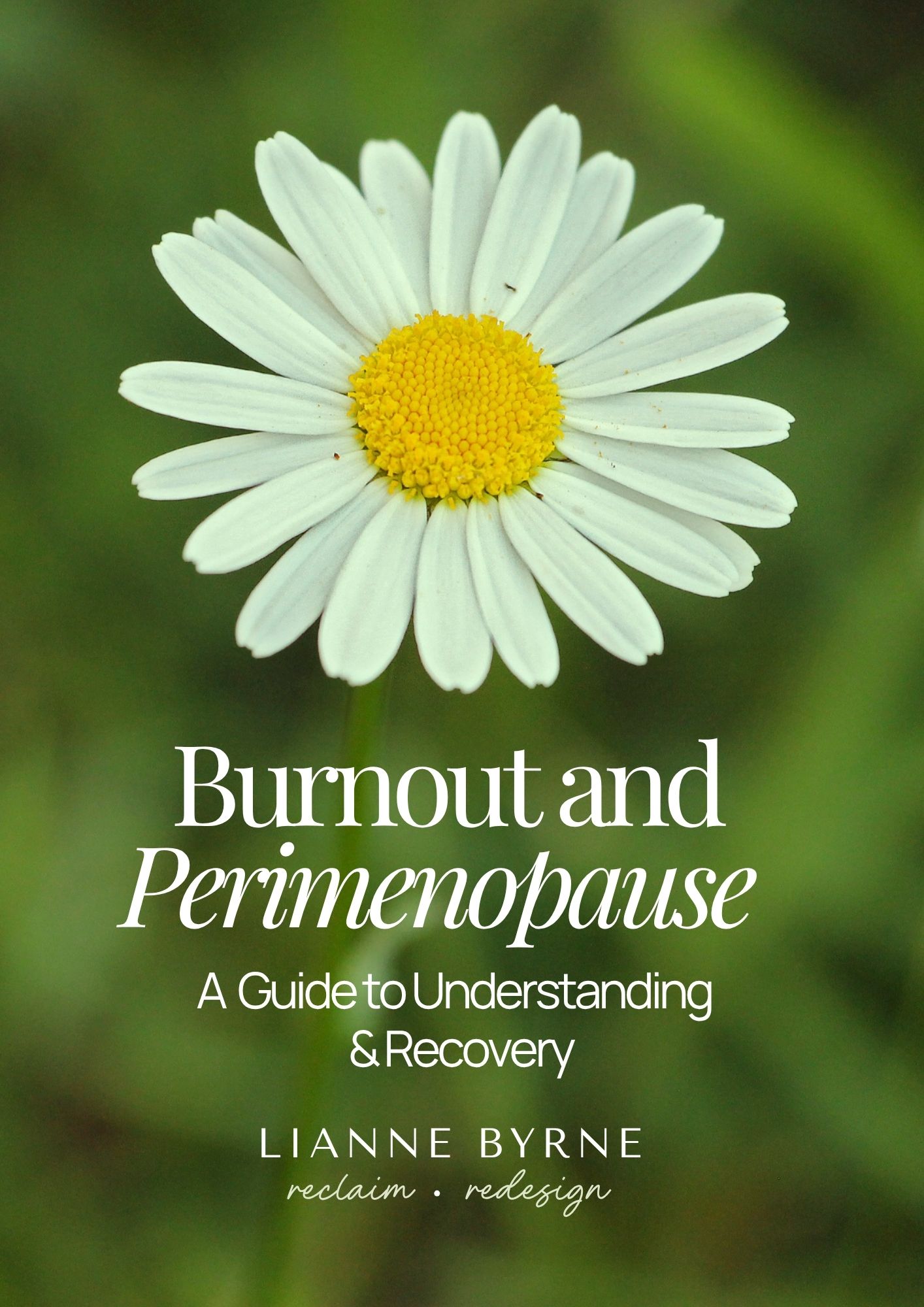
Disrupted sleep, brain fog, depleted energy, mood shifts: these are symptoms of both burnout and perimenopause. They amplify each other, and both are dismissed for too long. If you are navigating this intersection, the Burnout & Perimenopause Guide is a good place to start. It explains what may be happening, why the two overlap, and what to do next.
Burnout recovery coaching for women in midlife
The women I work with are high-functioning, capable, and exhausted. They come from two different contexts, but they are dealing with the same core problem.
✨ Women in employed roles
Senior, specialist, or leadership roles that demand more than they give back. You are delivering. You are reliable. But you are doing it on a system that is running on empty, and you are not sure how much longer you can maintain this.
✨ Women running their own businesses
You built something you believed in, and somehow it became the thing that is draining you. The flexibility you wanted turned into always-on. The independence became isolation. The work you loved started to feel like a weight.
What both have in common: you are the last person on your own list. You are brilliant at looking after everyone else. You are not brilliant at asking for what you need, or even knowing what that is anymore. That changes here.
What burnout recovery
actually looks like
Recovery is not a straight line. But it usually involves these four things, roughly in this order.
Understand what happened
Before anything changes, you need to understand what actually caused your burnout. Not just the obvious pressure, but the patterns underneath it. The people-pleasing, the overfunctioning, the inability to stop. We name it properly.
Recover your baseline
You cannot redesign from empty. The early weeks focus on giving your nervous system enough space to function clearly. Not Instagram self-care. Practical, specific changes that create genuine recovery.
Redesign the conditions
This is where the real work happens. What does work look like when it is actually sustainable? What do you want from your life, separate from what everyone else needs? We build it, specifically, for you.
Build what holds
We close by building the structures, boundaries, and practices that will hold you going forward, so recovery does not collapse the moment life gets busy again.
Not sure where you are right now?
The free Burnout Quiz takes three minutes. It gives you a clear picture of what you are experiencing and what it might mean, without requiring you to have it figured out first.
Common questions about burnout recovery coaching
The questions I actually get asked, answered without the coaching-speak.
What is burnout recovery coaching?
Burnout recovery coaching is a structured process that helps you understand why you burned out, address the patterns that led there, and redesign your work and life so you can recover properly, not just rest enough to go back to the same conditions.
It is different from therapy in that it is forward-focused and action-oriented. It is different from general life coaching in that it is grounded in the specific physiology and psychology of burnout: the depletion, the reduced capacity, the particular way it reshapes how you see yourself and your life.
How is burnout coaching different from therapy?
Therapy typically focuses on processing past experiences and mental health conditions. Burnout recovery coaching is present and future-focused. It works with where you are now, what is draining you, and how to build a life that does not keep burning you out.
Some women benefit from both simultaneously. If you are in mental health crisis, please seek a qualified therapist first.
Can I work with you if I am still employed, not running my own business?
Yes. Most of the women I work with are in employed roles: senior, capable, and running on empty. Burnout does not require you to be self-employed. What it requires is that something has to change, and together we work out whether that change is internal, structural, or both.
How long does burnout recovery take?
There is no honest single answer, because burnout is not linear. It depends on what is draining you, what you are carrying and what support you have.
The goal is not to get you back to who you were before. It is to get you to a version of your life that does not require you to burn out to maintain.
What if I am not sure I am burned out, or just very tired?
That uncertainty is worth taking seriously. Most women I work with spent months telling themselves they were just tired before something deeper became undeniable. The free Burnout Quiz takes about three minutes and will give you a clearer picture.
If you would rather talk it through, book a Flow Call. It is a conversation, not a sales pitch.
Do you work with women going through perimenopause?
Yes, and this intersection is something I know well, both personally and in my work with clients. Perimenopause and burnout share significant symptom overlap: disrupted sleep, brain fog, depleted energy, mood shifts. They amplify each other, and they are both often dismissed for too long.
The Burnout and Perimenopause Guide is a good starting point if you want to understand the overlap before we speak.
What does a session actually look like?
Sessions are held online. Structured but not rigid: we work with what is actually happening for you that week. You do not need to arrive with anything prepared. You just need to show up.
Further reading on burnout recovery

Why Women Burn Out Differently, and What Nobody Tells You About Recovery

The Overfunctioning Trap: Why Doing More Is Making Everything Worse

The Good Girl Conditioning That's Keeping You Compliant, and Exhausted

The Midlife Friction Point: Why Everything Feels Harder Right Now
The Capacity Reset
1:1 burnout recovery support for women in midlife who have nothing left to push through.
You don't need to redesign your whole life right now. We start by looking at what's draining your capacity and what can come off.
Book a Flow Call →