
Life Design
Stop working in your weakness zone
From school onwards, we receive a consistent message: identify what you're bad at, and work on it. P...
Read →

Lianne Byrne · May 2025
Photo: Mateus Guimarães on Unsplash
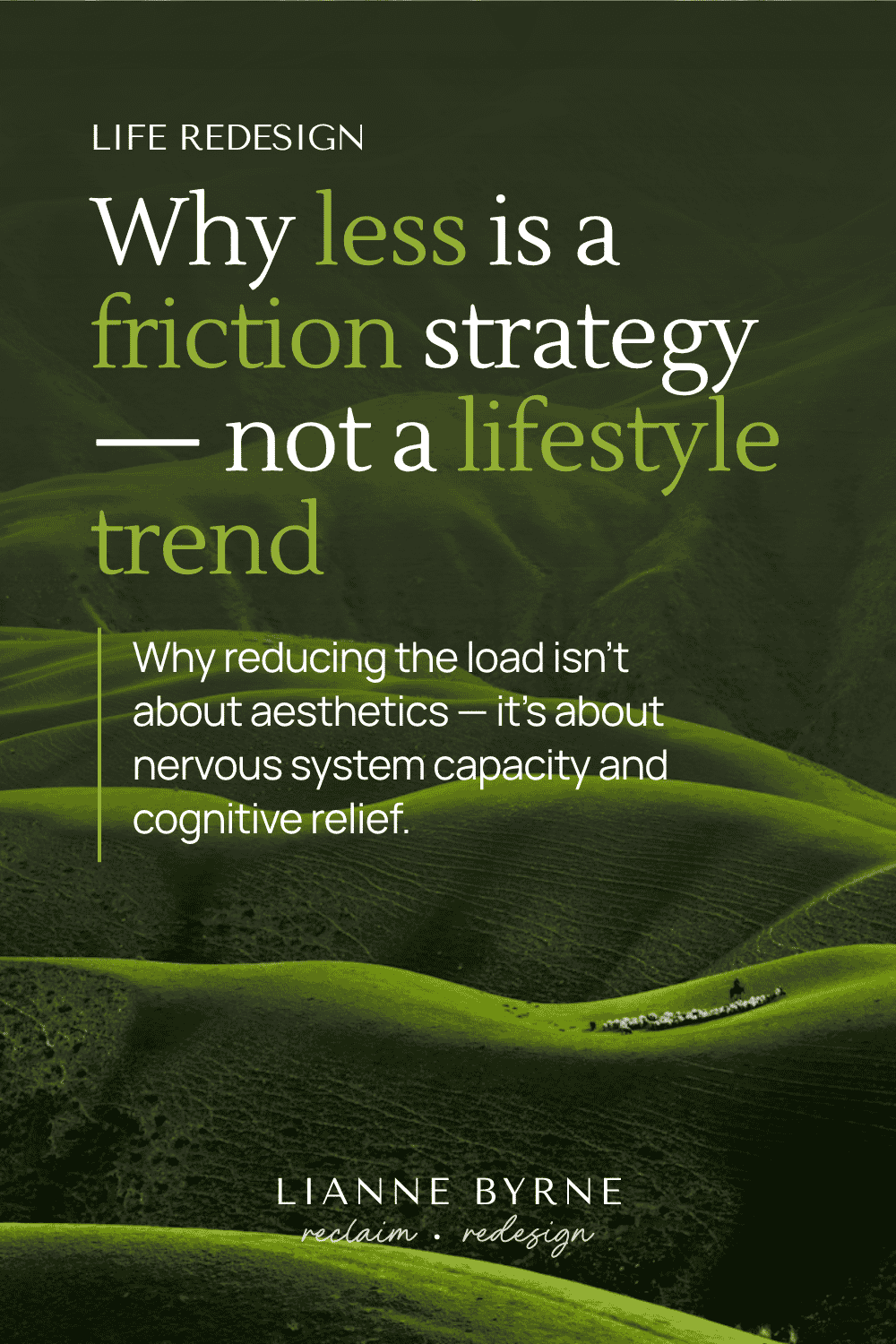
Minimalism has a branding problem.
It gets sold as an aesthetic — white walls, capsule wardrobes, people who own 47 possessions and photograph them beautifully. Which means most people scroll past it thinking: not for me. I have children. I like colour. I don't want to live like a Scandinavian concept store.
Fair enough. But the actual case for less has nothing to do with any of that.
The real reason to reduce is friction. Specifically: the cognitive load of managing, maintaining, finding, deciding about, and feeling vaguely guilty over too much stuff, too many options, and too many unfinished things.
That friction is real, it is measurable in energy and attention, and most people are carrying significantly more of it than they realise.
"Every object you own is a small, ongoing cognitive commitment. Every unfinished thing is an open loop. Every excess option is a micro-decision waiting to happen. Less isn't about deprivation — it's about reducing the load."
Every choice costs cognitive energy — even trivial ones. What to wear. Which pan to use. Which route to take. Individually negligible; collectively significant. The more options you maintain, the more decisions you're making. Reducing options — a simpler wardrobe, fewer tools, meal templates — isn't laziness. It's preserving decision-making capacity for things that actually require it.
Every unfinished project, every item that needs repair, every commitment you half-made and haven't followed through on — these are open loops. Your brain keeps them in working memory, quietly scanning for resolution. The cognitive cost is subtle but continuous. Closing loops — finishing, delegating, or consciously abandoning — frees up that background processing for things that actually deserve it.
Everything you own requires some maintenance: cleaning, storing, insuring, repairing, replacing, finding, organising. The more you own, the more time and attention goes into managing it. This is rarely counted explicitly, which is why people underestimate how much of their week goes to maintaining a quantity of possessions that isn't actually making them happy.
Visual clutter is cognitively expensive. A disordered environment creates a persistent low-level sense of incompletion — a background signal that there is work to be done. This is not about perfectionism. It is about the fact that your brain processes your environment continuously, and a cluttered space is continuously generating low-grade noise that competes with focused attention.
Overscheduling is the relational equivalent of owning too much. Every commitment on your calendar — the standing coffee that's become obligatory, the committee you joined years ago, the social obligation you maintain out of habit rather than genuine want — carries a cognitive and emotional cost. Periodically auditing your commitments the same way you'd audit your possessions is one of the highest-leverage things you can do.
The low-friction question to apply to anything — an object, a commitment, a habit, a relationship dynamic — is not "do I love this?" or "could this be useful someday?" It is simpler and more honest than either of those:
Does this generate more energy than it costs to maintain?
Some things are worth the cost: a possession you use every week and genuinely enjoy, a commitment that feeds you even when it's demanding, a relationship that gives as much as it takes. These are worth carrying.
What's not worth carrying: the things you maintain out of guilt, habit, a vague sense of obligation, or because getting rid of them would require a decision. These are friction generators with no corresponding return.
You don't have to do this all at once — and you don't have to become a minimalist in the Instagram sense. You just have to become more honest about the actual cost of everything you're maintaining, and more willing to put down the things that aren't earning their place.
Less is not deprivation. It is the creation of space — for attention, for energy, for the things that actually matter to you. That is as practical as it gets.
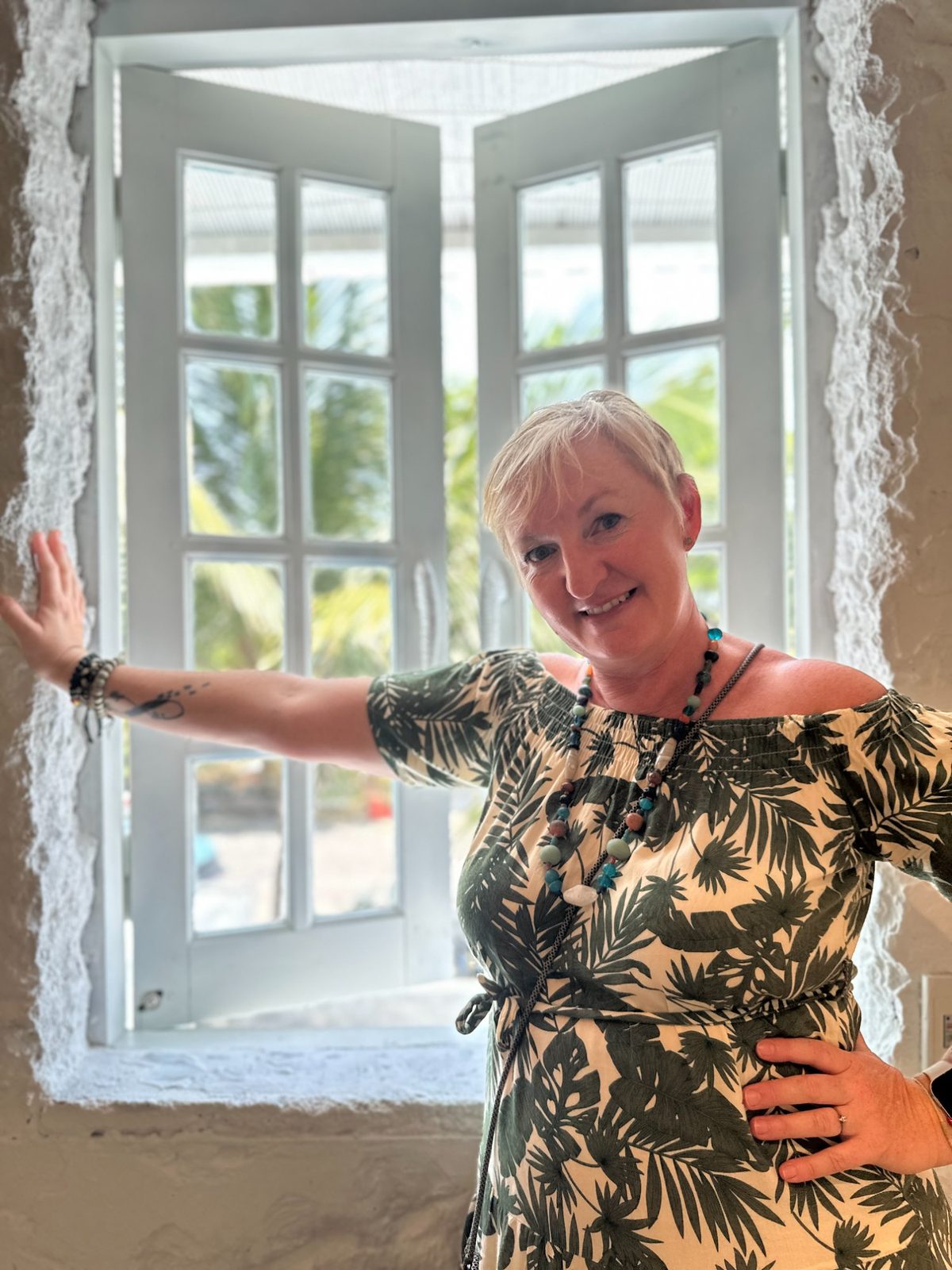
25 years in digital and marketing. Burnout survivor. ADHD at 43. Coaching women in midlife through the Designed to Flow process. Currently worldschooling in Guatemala.
Free · about 3 minutes
The Free Flow Life Audit shows where your life still fits, where something's getting in the way, and where to look first.
Take the Free Flow Life Audit →
Life Design
From school onwards, we receive a consistent message: identify what you're bad at, and work on it. P...
Read →
Life Design
My youngest daughter went through a phase of asking why about everything. Relentlessly. Exhaustingly...
Read →
Burnout & Recovery
In 2021, I sat in my doctor's office and couldn't stop crying. I couldn't even explain why — when sh...
Read →Keep reading
Essays about midlife, burnout, identity, work, life redesign and figuring out what comes next.
New essays are published on Substack.
Read & subscribe →